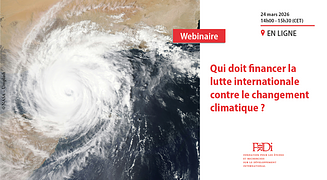
Webinar: "Who should finance the international fight against climate change?"

March 24, 2026, En ligne

FERDI launched a series of three webinars on "Reconciling international development financing with global public goods financing."

FERDI launched a series of three webinars on "Reconciling international development financing with global public goods financing." :

  • Resource mobilisation
  • The allocation of funding for adaptation and mitigation
  • Measuring these funding flows.

The first of these webinars addressed the mobilization of the resources needed to combat climate change, and more specifically the distribution of the burden of this financing. 

Register

📅March 24, 2.00–3.30 pm (CET)

Online – register HERE 

Simultaneous translation: French / English 

Who should finance the international fight against climate change?

Context

The architecture of climate change financing, inherited from major UN conventions, is based on a burden-sharing approach that has become increasingly disconnected from contemporary economic and climate realities. In particular, the concentration of financial contributions from a limited number of countries, mainly in Europe, raises major questions about fiscal sustainability, political legitimacy, and collective effectiveness. These questions are all the more pressing given that the international context is marked by growing geopolitical fragmentation, the decline of multilateralism, particularly in the environmental sphere, and the gradual questioning of its normative foundations.

The panel will bring together experts and representatives from think tanks in rich and emerging countries, and poor countries that are vulnerable to climate change. 

Objectives

  • Analyse the profound transformations in the global economy and in the geography of greenhouse gas emissions, as well as their implications for the principles of common but differentiated responsibilities and respective capabilities.

    The discussion focused on the evolution of emissions, the rise of new major emitters and potential contributors, and the implications for an international climate finance system that continued to be based largely on inherited country categories.

  • Provide an opportunity to examine the conditions for rebalancing the international financial effort in order to guarantee the credibility of climate finance, the protection of the most vulnerable countries, and the political viability of the multilateral system in the medium and long term..
Speakers

Moderator: Matthieu Boussichas, Programme Manager at FERDI

Presentation: Patrick Guillaumont, President of FERDI


Panelists:

Ms Sylvie Lemmet, former French Ambassador for the Environment, Senior Fellow at FERDI, member of the FERDI Chair on the International Architecture of Development Finance

Ms Gaia Larsen, Director of Climate Finance Access at the Center for Sustainable Finance, World Resources Institute (WRI)

Mr Karim El Aynaoui, Executive Chairman of the Policy Center for the New South, Executive Vice President of Université Mohammed VI Polytechnique

Ms Amrita Goldar, Senior Researcher at the Indian Council for Research on International Economic Relations (ICRIER)

Mr Justin Yifu Lin, former Chief Economist and Senior Vice President of the World Bank, Dean of the Institute of New Structural Economics (INSE)

Mr Guillaume Pottier, Director of the Development and Climate Finance Programme at the Institute for Climate Economics (I4CE)

Ms Vahinala Raharinirina, Vice President of the University of Fianarantsoa, former Minister for the Environment and Sustainable Development of Madagascar, Senior Fellow at FERDI