Reconciling International Development Finance with the Financing of Global Public Goods
July 24, 2026




FERDI launched a series of three webinars on “Reconciling international development financing with the financing of global public goods”:
• Resource mobilisation: “Who should finance the international fight against climate change?”, March 24, 2026 >> Watch the video
• The allocation of funding for adaptation and mitigation
• Measuring these funding flows
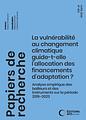
The second webinar in this series addressed the allocation of funding for adaptation and mitigation.
Whilst the mobilisation of resources for development is a major challenge, their distribution among countries, particularly that of concessional resources, is at least as important. It must be noted, however, that it generally receives less attention. Yet it is crucial to the effectiveness and equity of the international development financing system, particularly today in a context of accelerating scarcity of these resources.
The question of the allocation of concessional resources arises at two levels: between objectives, particularly between development and global public goods (GPGs), and between countries.
The allocation of concessional resources between objectives is far from being clearly defined, but the international commitments made regarding development and climate finance nevertheless outline some distribution rules, notably: for development, the 0.7% commitment – although this is becoming increasingly hypothetical – and for climate finance – the quintessential GPG – the US$300 billion per year expected from developed countries and the tripling of resources for adaptation by 2035.
Each objective should be more clearly distinguished at the global level and within each financing institution – given that there are also a number of specific funding streams for each major objective. This raises the more concrete question of the geographical distribution of resources mobilised for each objective or within each window: this is the second level of allocation, the country-level allocation, applied to each financing objective.
However, the nature of the objectives, and therefore of their respective windows, is fundamentally different: development and global public goods certainly complement one another and sometimes overlap, but they pursue distinct aims.
Consequently, not all concessional resources should be allocated according to the same rules. Those aimed at development should be directed primarily towards the poorest and most vulnerable countries, based on their needs and financing constraints. Those aimed at global public goods, in particular climate change mitigation, should be allocated according to their contribution to the global collective interest.
Climate change adaptation occupies an intermediate position: because its benefits are primarily local and linked to vulnerability to climate change, it should be subject mainly to a needs-based allocation approach.
The webinar therefore aimed to discuss these positions and how they might be translated into specific rules: Given that concessional financing currently serves the purposes of development, adaptation to climate change and the provision of global public goods – notably climate change mitigation – what specific rules should drive its allocation to ensure it remains fair, effective and consistent with each of these objectives?
Moderator: Patrick Guillaumont, President of FERDI
Panelists:
French version:
English version: